
6-Session RCT: Infrared Sauna for Clinics and Patients — Evidence and Supervised Care
- Bill Smith
- 10 hours ago
- 7 min read


Infrared saunas have real, evidence-backed benefits for certain conditions, especially short and mid-term pain relief in fibromyalgia and inflammatory arthritis, plus support for muscle recovery and relaxation. The strongest long-term cardiovascular data still favors traditional saunas, and anyone with heart disease, blood pressure medication, or pregnancy should get clinical guidance before starting.
TL;DR:
Infrared saunas provide short-term pain relief for fibromyalgia and arthritis, supported by studies showing significant reductions in pain and stiffness.
They show cardiovascular benefits mainly in specific populations like heart failure patients, but long-term mortality data still favors traditional saunas.
Individuals with heart conditions, pregnancy, or blood pressure medication should seek medical guidance before use to avoid risks like dehydration or blood pressure drops.
Infrared therapy benefits are most evident in chronic pain and injury recovery, while weight loss and detox claims are unsupported by evidence.
Table of Contents
What Is an Infrared Sauna, and How Does It Differ From a Traditional Sauna?
A traditional sauna heats the air around you, often past 150°F, and your body absorbs that heat through the surrounding atmosphere. An infrared sauna works differently. It uses far-, mid-, or near-infrared light to warm your tissue directly, without needing to heat the whole room to the same extreme. That’s the core answer to how does infrared sauna work: it’s radiant heat penetrating skin and muscle, not ambient air doing the job.
Because of that mechanism, infrared cabins typically run at a lower temperature than traditional saunas. For someone who finds high heat unbearable, that lower range often means longer sessions become tolerable rather than something to escape after five minutes.
Practically, infrared units are also easier to place in a clinic or home. Many run on a standard 120V outlet, which sidesteps the special electrical work traditional saunas can require. Analysts who cover the infrared vs. traditional sauna debate argue this practical fit matters more than which one is theoretically “better,” since the one you’ll actually use consistently is the one that produces results.
What Are the Real Health Benefits of Infrared Saunas?
Each claimed benefit deserves its own honest look, because the evidence quality varies a lot from one outcome to the next.
Cardiovascular health. Far-infrared trials in heart-failure patients, following the WAON-CHF protocol, showed improved cardiac index and reduced BNP levels, a marker of cardiac strain. That’s meaningful for a specific clinical population, but the strongest long-term mortality data, the kind that tracks people for years, still comes from studies on traditional Finnish-style saunas.
Infrared sauna for pain relief and arthritis. This is where the evidence gets genuinely compelling. A pilot study of infrared whole-body hyperthermia in rheumatoid arthritis and ankylosing spondylitis patients found statistically significant short-term drops in pain and stiffness during an eight-session course, with no adverse effects reported.
Muscle recovery. Heat exposure raises heat-shock protein activity, which plays a role in cellular repair and dialing down inflammation. Traditional saunas tend to trigger a stronger HSP response, but infrared still produces a measurable one, enough to support its use after tough workouts or rehab sessions.
Relaxation and sleep. Small trials point to a shift toward parasympathetic (“rest and digest”) nervous system activity after infrared sessions, along with reported quality-of-life improvements. The effect sizes here are modest but consistent.
Immune function and illness prevention. This is the weakest claim on the list. There’s a plausible physiological rationale, mild heat stress can trigger some immune signaling, but clinical evidence in humans is thin. Treat any “boosts immunity” claim with real skepticism until better trials exist.
What Do the Clinical Trials Actually Show?
The single strongest piece of evidence for infrared sauna pain relief is a 2023 randomized, sham-controlled trial testing mild water-filtered infrared-A whole-body hyperthermia in fibromyalgia patients. Six treatments over three weeks produced pain reductions that held up statistically at week four (p = 0.015) and remarkably still at week thirty (p = 0.002), well after treatment ended.

The 2008 pilot study in rheumatoid arthritis and ankylosing spondylitis patients ran eight infrared sessions over four weeks across 17 patients per group, and found short-term pain and stiffness relief that patients tolerated well.
Cardiovascular evidence sits in a more nuanced spot. Cohort studies with decades of follow-up back traditional sauna use for reduced cardiovascular mortality, while infrared-specific trials like WAON-CHF show benefit mainly in narrower, monitored heart-failure populations. Dry sauna research on low back pain adds further support that heat therapy broadly reduces pain scores and disability measures.
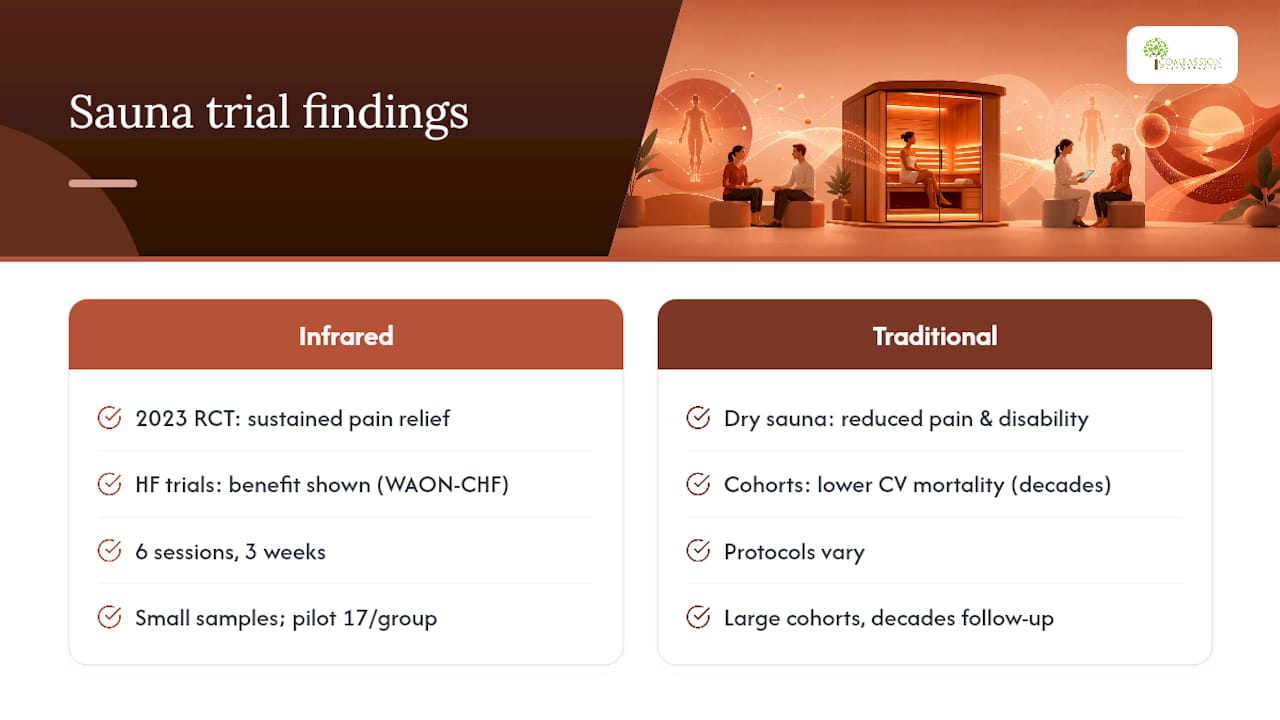
Readers should know the honest limits here too: most infrared studies use small samples, mix different infrared modalities, and follow patients for only weeks rather than years. Larger, longer trials are still needed.
How Do You Use an Infrared Sauna Safely and Effectively?
Clinical trials weren’t built around random single sessions. They used structured, repeated regimens, and that consistency appears to matter as much as the heat itself.
Start with shorter sessions. Fifteen to 20 minutes is a reasonable starting point, working toward 30 to 45 minutes as tolerance builds.
Follow a repeated schedule. The fibromyalgia trial used repeated sessions over several weeks; the arthritis pilot used a similarly repeated treatment regimen. Two to three sessions weekly mirrors that structure better than one occasional visit.
Hydrate before and after. Infrared sessions cause real fluid loss even at lower cabin temperatures, so drink water beforehand and rehydrate immediately after.
Monitor how you feel. Mild lightheadedness on standing is common; anything beyond that is a signal to stop.
Pair it with movement. Light stretching or clinician-guided rehab exercises after a session, when muscles are warm, tends to improve outcomes more than the sauna alone.
Pro Tip: Treat your first two weeks like a short clinical trial of one, three sessions a week, same length each time, and track your pain or stiffness daily. That consistency is exactly what the fibromyalgia and arthritis studies relied on to show measurable improvement.
Who Should Avoid Infrared Saunas or Use Extra Caution?
Infrared heat is gentler than a traditional sauna, but it isn’t risk-free. Dehydration and a drop in blood pressure are the most common issues, especially for anyone on antihypertensive medication or diuretics, since heat exposure can amplify both drugs’ effects. Pregnant patients and people with pacemakers or other implanted devices should get medical clearance first.
Watch for lightheadedness, a racing heartbeat, or nausea mid-session, and stop immediately if any of those appear. It’s worth remembering that the clinical trials behind these benefits actively monitored vital signs and excluded patients with unstable cardiac conditions, a screening step worth replicating outside a research setting.
Who Actually Benefits Most From Infrared Sauna Use?
Chronic pain conditions, fibromyalgia especially, plus rehab support after injury, show the clearest evidence. Weight loss and “detox” claims don’t hold up nearly as well and shouldn’t be the reason you start. Expect meaningful but modest relief, and only with a consistent multi-week regimen, not a single visit. Anyone with cardiac disease, pregnancy, or blood pressure medication should check with a clinician first.
How Compassion Chiropractic Uses Infrared Sauna in Patient Care
Since 2009, Compassion Chiropractic has paired walk-in chiropractic care with infrared sauna sessions, screening each patient first and tracking pain and mobility progress alongside adjustments and rehab.
An Editorial Take on Infrared Sauna Evidence
The conventional wisdom on infrared saunas splits into two camps that are both a little wrong. One camp treats it as a wellness luxury with vague “detox” benefits. The other dismisses it entirely because the mortality data favors traditional saunas. Neither reading holds up against the actual trial evidence.
What the research genuinely supports is narrower and more useful: infrared sauna works best as a structured, repeated intervention for specific pain conditions, not a spa treat you do occasionally. The fibromyalgia trial’s 30-week follow-up result is the detail most articles skip past, and it’s the most important one. Pain relief that persists months after six sessions end suggests something physiological is happening, not just short-term comfort.
Where I’d push back on common advice is the framing around “which sauna type is better.” That question matters less than whether a person will actually complete a consistent regimen. A tolerable, lower-heat option someone uses three times weekly for a month will likely outperform an intense traditional sauna session they dread and skip.
— James
Try a Supervised Infrared Sauna Session at Compassion Chiropractic
Compassion Chiropractic gives you a supervised, screened path into infrared therapy instead of guessing alone at home. There’s no membership lock-in and no appointment backlog, walk in, get assessed, and start the same day if it’s appropriate for you.

Here’s what a first visit typically includes:
A screening conversation covering medications, blood pressure history, and any cardiac concerns
A session length matched to your tolerance, building gradually over follow-up visits
Integration with chiropractic adjustments and rehab work when it fits your condition
Progress tracked visit to visit, the same way the clinical trials tracked pain and stiffness scores
If chronic pain, stiffness, or recovery from an injury has you curious about whether infrared therapy could help, book an appointment online or explore the full range of services to see how sauna sessions pair with the rest of your care plan.
This article is general information, not a substitute for advice from a qualified doctor. Consult a qualified healthcare professional about your own circumstances before acting on anything here.
Sources
Recommended
Comments