
Does Insurance Cover Chiropractic Care in the U.S.?
- Bill Smith
- Aug 19
- 8 min read


Yes, most health insurance plans cover chiropractic care, but only for medically necessary spinal manipulation, and only within the limits your specific plan sets. Medicare, Medicaid, and commercial insurers each draw the line differently, and none of them pay for care once your records show you’ve plateaued.
Before your first visit, do three things:
Call your insurer and ask specifically about chiropractic benefits, not just “physical therapy.”
Confirm in-network status, prior authorization, and your annual visit cap.
Ask the clinic to verify billing codes before treatment starts, so nothing gets billed as a surprise.
Pro Tip: Medicare and Medicaid follow different rules than employer or marketplace plans, and neither pays for “maintenance” adjustments, so read the Medicare and Medicaid sections below before you assume anything about your own coverage.
Key Takeaways
Insurance typically pays for medically necessary spinal manipulation, but Medicare, Medicaid, and commercial plans each cap, code, and document that coverage differently.
Point | Details |
Coverage is conditional | Insurers pay for active spinal manipulation, not maintenance or wellness adjustments. |
Medicare covers one service | Part B pays only for manual manipulation of a subluxation, with 20% coinsurance after the deductible. |
Medicaid varies by state | Check your specific state Medicaid handbook rather than assuming national rules apply. |
Documentation drives approval | CPT codes 98940 to 98942, ICD-10 diagnosis, and progress notes support claims and appeals. |
Verify before you start | Compassion Chiropractic checks your benefits and separates covered from non-covered services before treatment begins. |
Where to Confirm the Rules Yourself
Your state’s Medicaid site or handbook
Your plan’s SBC or Evidence of Coverage document
This article is general information, not a substitute for advice from a qualified doctor. Consult a qualified healthcare professional about your own circumstances before acting on anything here.
Table of Contents
What Chiropractic Care Includes and Why Insurers Treat It Differently
Chiropractic care centers on manual spinal manipulation, the hands-on adjustment technique used to treat joint restriction and misalignment. Most clinics also offer adjunct services, evaluation and management, therapeutic exercise, massage, acupuncture, and sometimes supplements or nutritional counseling.
Insurers usually treat these very differently:
Typically billable: spinal manipulation, initial evaluation, re-exams tied to a diagnosis.
Often separate or excluded: massage therapy, acupuncture, supplements, wellness checkups.
Insurers require proof of measurable improvement because chiropractic benefits are built around active, corrective treatment, not comfort care. If your chart shows the same complaint for months with no functional gain, most health insurance plans stop paying, even if you feel the visits still help.
Pro Tip: Ask your chiropractor’s office which of your visit’s line items are billed to insurance and which are self-pay. That single question prevents most surprise bills.
Does My Plan Cover Chiropractic Treatment?
Coverage hinges heavily on plan type. HMOs generally require a primary care referral and strict in-network rules. PPOs allow more flexibility to see out-of-network providers, usually at a higher coinsurance rate. High-deductible health plans (HDHPs) technically cover chiropractic once you meet the deductible, but you’ll pay full price out of pocket until then.
A few real-world patterns show up constantly:
A PPO patient can often walk into an in-network chiropractor without a referral, though visit caps still apply.
An HMO patient may need a referral from their primary doctor before a single adjustment gets covered.
An HDHP patient might pay $150 to $200 out of pocket for the first several visits before insurance kicks in at all.
Marketplace and employer plans aren’t required to treat chiropractic as an essential health benefit under the Affordable Care Act, so coverage depends entirely on your specific plan and state. Your Summary of Benefits and Coverage (SBC) or your insurer’s member portal will spell out your exact visit limits and cost-sharing. Healthcare explains how network rules and referral requirements vary across plan types, and it’s worth a read before you assume anything based on a friend’s plan.
Does Medicare Cover Chiropractic Care?
Medicare Part B covers exactly one chiropractic service: manual manipulation of the spine to correct a documented subluxation. That’s it. X-rays, massage, acupuncture, and supplements ordered by a chiropractor are excluded outright, even if they’re clinically reasonable.
Covered: spinal manipulation for subluxation, with documentation.
Excluded: X-rays, massage therapy, acupuncture, supplements, maintenance adjustments.
Here’s the cost math. After you meet the annual Part B deductible, you typically pay 20% coinsurance on the Medicare-approved amount for each covered adjustment. A $65 approved visit costs you around $13 out of pocket once the deductible is satisfied. Medicare Advantage plans sometimes extend beyond Original Medicare’s narrow rule, adding limited coverage for exams or therapies, so it’s worth checking your Advantage plan’s Evidence of Coverage directly rather than assuming Original Medicare’s rules apply.
Does Medicaid Cover Chiropractic Treatment?
Medicaid chiropractic coverage varies dramatically by state. Some states offer generous visit allowances that exceed commercial insurance; others exclude chiropractic almost entirely except for pediatric or maternity-related exceptions.
To find out where you stand:
Check your state Medicaid website or handbook for a chiropractic benefits section.
Call your state Medicaid member services line and ask specifically about spinal manipulation coverage and visit caps.
If you’re dual-eligible for Medicare and Medicaid, ask how the two coordinate, since Medicaid sometimes picks up coinsurance Medicare leaves behind.
What Chiropractic Services Are Covered vs Excluded?
The same visit can straddle both categories. Your adjustment gets billed to insurance while your massage or supplement purchase gets billed to you directly.
Commonly covered:
Manual spinal manipulation for a diagnosed condition
Initial evaluation and periodic re-exams tied to that diagnosis
Commonly excluded:
Maintenance or wellness adjustments with no active treatment plan
Adjunct therapies like massage, acupuncture, and supplements
Diagnostic imaging ordered by the chiropractor in many plans
This split matters because a single appointment for chiropractic adjustment might generate two separate charges, one processed through insurance and one paid directly.
Pro Tip: Ask the front desk to itemize your bill and code each service separately. That way you can see exactly which charges went to insurance and dispute anything that looks off.
What Will Chiropractic Care Cost Me Out of Pocket?
Four variables drive your actual bill: the deductible, your copay or coinsurance percentage, the insurer’s “allowed amount,” and whether your provider is in-network. Out-of-network care can trigger balance billing, where you owe the difference between what your insurer paid and what the provider charged.

Plans commonly cap chiropractic at 20 to 30 visits per year, and many require prior authorization for the initial course of care rather than approving unlimited visits upfront.
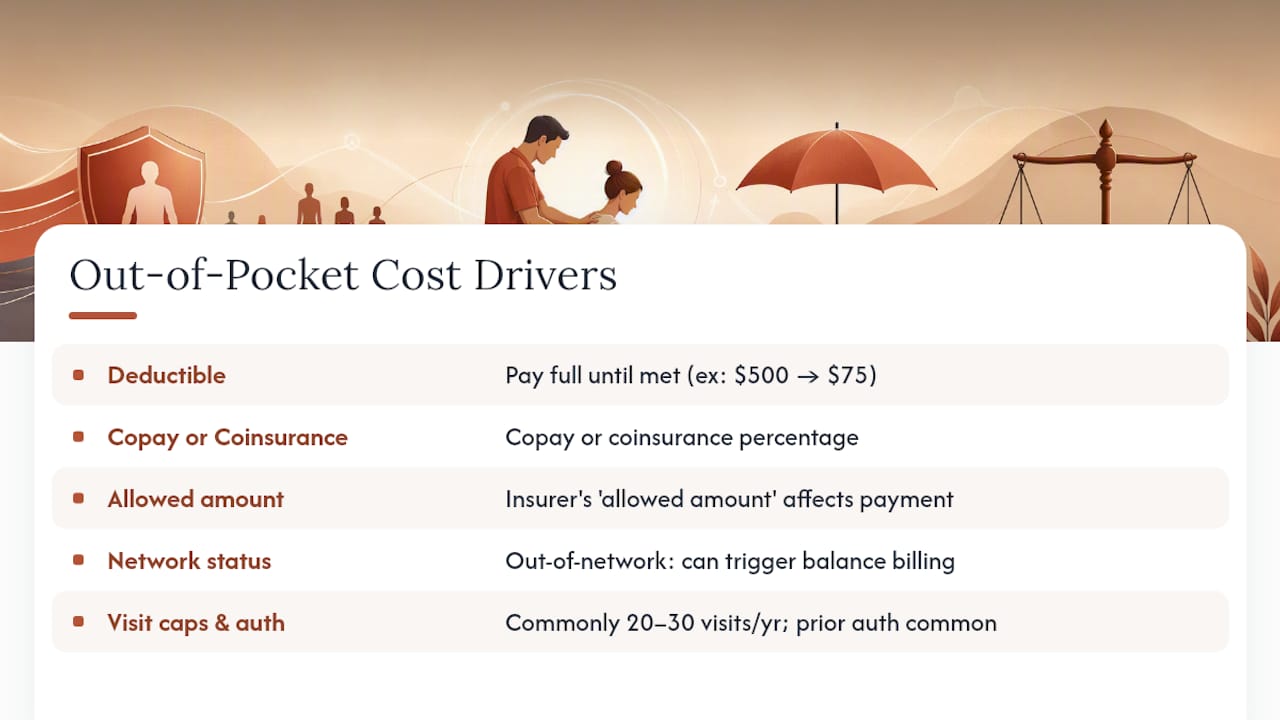
Here’s a simple example. Say your plan has a $500 deductible you haven’t met, and a visit costs $75. You’d pay the full $75 toward your deductible.
How Do You Verify Chiropractic Coverage Before Treatment?
Identify your plan type (HMO, PPO, HDHP, Medicare, Medicaid) from your insurance card or enrollment documents.
Read your SBC or Evidence of Coverage for the chiropractic benefits section specifically.
Call member services and ask: Is chiropractic covered? What’s my visit cap? Is prior authorization required?
Get prior authorization in writing if your plan requires it, before your first visit.
Confirm the clinic is in-network and ask what CPT codes they’ll bill under your plan.
Pro Tip: Write down the representative’s name, the date, and the reference number for every insurance call. If a claim gets denied later, that record becomes your strongest evidence during an appeal.
What Documentation Supports a Chiropractic Insurance Claim?
Insurers, including Medicare, generally require billing under CPT codes 98940 through 98942, which distinguish treatment by the number of spinal regions adjusted. Medicare also requires the AT modifier to signal active, corrective treatment rather than maintenance care.
Diagnosis coded to ICD-10, tied to a specific functional limitation
Progress notes showing measurable improvement visit to visit
Correct CPT code and, for Medicare, the AT modifier attached
Documentation gaps are the leading cause of claim trouble. A CMS-reported CERT review found a 41% error rate on chiropractic claims, driven mostly by insufficient records rather than fraud.
Pro Tip: If a claim gets denied, request copies of your visit notes and any X-rays directly from the clinic. You’ll need them to support an appeal.
What Happens at Your First Chiropractic Visit?
Expect an intake form, a physical exam, and usually an adjustment on the same day. The exam and adjustment are typically what gets billed to insurance; anything beyond that (massage, supplements) usually isn’t.
Before you sit down for treatment, ask the front desk:
Will you bill my insurance directly?
What’s my expected out-of-pocket share today?
Are any of today’s services likely non-covered?
Bring your insurance card and ask for pre-visit benefit verification if you want certainty before treatment begins.
How Do You File a Chiropractic Claim or Appeal a Denial?
Most clinics submit claims directly to your insurer, so your job is mainly to watch for the Explanation of Benefits (EOB) and check the denial reason code if one shows up.
Confirm the clinic submitted the claim with correct codes.
Review your EOB for the specific denial reason.
Gather progress notes, ICD-10 codes, prior authorization approvals, and imaging.
Write an appeal letter referencing that documentation directly.
If Medicare denies a service as non-covered, keep that denial notice. Secondary insurance, including some Medicaid programs for dual-eligible beneficiaries, often requires proof that Medicare denied the claim before they’ll consider paying it themselves.
Why Do Insurers Exclude Maintenance Chiropractic Care?
CMS policy limits Medicare coverage strictly to manual manipulation for a documented subluxation, explicitly excluding maintenance therapy, which it defines as treatment that isn’t expected to result in further clinical improvement.
The American Chiropractic Association has pushed for more consistent, evidence-based chiropractic benefit structures across payers, noting that coverage remains inconsistent between commercial insurance, Medicare Advantage, and Medicaid, even for comparable diagnoses.
Clinicians who document specific functional gains, like increased range of motion or reduced pain scores tied to daily activities, give insurers a clearer reason to keep paying than vague notes repeating the same complaint visit after visit.
How Compassion Chiropractic Handles Insurance Verification
We check your benefits before your first adjustment, not after, so you’re not guessing about cost. Our team separates covered spinal manipulation from adjunct therapies like red light therapy or nutritional counseling, and we tell you upfront which charges go to insurance and which don’t.
Walk-ins get a benefit estimate before treatment starts, and we help patients gather documentation for appeals when a claim gets denied. You can book online or walk in directly for a same-day check.
How Compassion Chiropractic Helps You Use Your Insurance
If you’ve read this far, you know chiropractic coverage comes with real fine print. That’s exactly why Compassion Chiropractic checks your benefits before you ever sit in the treatment chair, so you know your visit cap, your copay, and what’s likely to land on your own tab, not after the fact.

Since 2009, we’ve run a walk-in model built around getting patients answers fast, without weeks of phone tag with your insurer. Our front desk handles the parts most patients dread:
Insurance benefit checks before your first visit
Prior authorization support for plans that require it
Itemized billing that separates covered adjustments from adjunct therapies
Help gathering documentation if you need to appeal a denial
Our affordable chiropractic care is built for patients who need clarity, not surprises, on cost. Bring your insurance card and any referral your plan requires, and we’ll walk you through what’s covered before treatment starts. Book online today or walk into our Palm Bay clinic to get your benefits checked on the spot.
Sources
Recommended
Comments